
This article documents the end-to-end development approach behind the teenee-property.com platform, written as a rigorous (yet readable) case study suitable for Pimclick’s blog.
Where the public website provides verifiable evidence (site structure, content patterns, privacy posture, partner roles), this report cites those sources directly; where implementation details are not disclosed (exact CMS, internal repositories, budgets, scraping sources, production metrics), they are explicitly marked unspecified rather than inferred. [1]
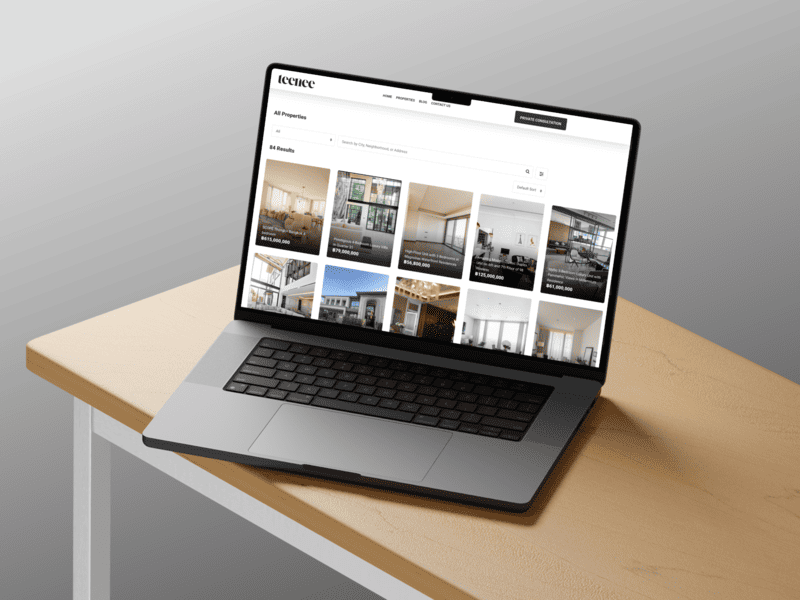
From a product perspective, the platform behaves like a luxury real-estate “discovery + conversion engine”: a large, filterable property catalogue (84 results on the “All Properties” view), property detail pages optimized for decision-making and lead capture (consultant block + “Contact Agent / Request Tour”), and a content-led SEO layer via a multi-page blog and tag taxonomy. [2]
From an ecosystem perspective, the site publicly states that Pimclick supports strategic marketing, performance campaigns, SEO, UX, and continuous website maintenance, and that the site is “Designed by Pimclick” in the footer. Hosting/cybersecurity/monitoring are described as covered by Pimhoster; legal and PDPA-related needs are presented as handled by Pimlegal. [3]
Business metrics (traffic, Core Web Vitals field data, conversion rates) are unspecified in public materials; consequently, we include an instrumentation blueprint based on official documentation for analytics, Search Console reporting, structured data, and performance measurement. [4]
Conception
Project goals
The site’s user-facing promise is explicit: “Discover Bangkok’s finest luxury condos and penthouses for sale and rent,” positioning the platform as a premium marketplace focused on high-end buyer intent and guided consultation. [5]
On property detail pages, the conversion objective is reinforced by a consistent CTA pattern (“Speak With a Personal Consultant” and direct actions to contact or request a tour), indicating that the primary success event is not “time on site,” but lead generation and qualification. [6]
Target users
The Partners page describes the intended audience as high-net-worth buyers, investors, and expatriates seeking to establish themselves in Bangkok, and frames the brand proposition as a “curated network” covering lifestyle, compliance, and relocation enablement (not purely transactions). [7]
In this segment, the UX goal shifts from “maximum inventory browsing” to “minimum uncertainty”: clarity on location, transport access, amenities, and a low-friction route to a trusted human contact. [8]
Information architecture
The navigation structure is intentionally shallow (Home → Properties → Property detail; Home → Blog → Article; plus Partners and Contact). This is visible across top navigation and repeated footer menus. [9]
Within Properties, the IA is built around filters that match real buyer decision variables (price, beds/baths, property type, size, amenities) and exposes “All / Buy / Rent” as the primary segmentation. [10]
Within Blog, the IA shows pagination (“Page 1 of 13”), “Latest Articles,” and a tag taxonomy (“Popular Tags”), indicating an SEO-driven content model designed to scale. [11]
Image placeholder (internal): Insert your own annotated screenshots for (1) filter panel + results count, (2) the consultant CTA block on a property detail page, (3) the blog listing with pagination and tag module.
Data scraping and data governance
What is known vs unspecified
The public site confirms that there is a structured property catalogue with consistent fields and filtering, and that individual property pages contain normalized attributes (offer type, property type, neighborhood, transit station, amenities). [12]
However, the platform does not publicly disclose where the inventory is sourced from (agent feeds, MLS-like sources, developer partnerships, internal CRM, authorized public listings, etc.), nor the refresh cadence. These inputs are therefore unspecified.
Sources and acquisition methods
In a luxury property context, a compliant acquisition strategy typically prioritizes (in order):
1) Direct partner feeds (API, CSV exports, shared databases)
2) Internal curated stock (agent network)
3) Scraping only where allowed by contract/terms and where it does not violate legal/ethical constraints
If scraping is used, tools like Scrapy (crawling + extraction + pipelines) are designed explicitly for building scalable crawlers and structured extraction workflows. [13]
For simpler single-page collection or targeted endpoints, Requests (HTTP client) and Beautiful Soup (HTML/XML parsing) are common building blocks. [14]
For heavily JavaScript-driven sites (or for automated QA of rendered output), Playwright is a standard option; its official docs emphasize cross-browser automation and a strong testing workflow. [15]
Frequency and refresh strategy
Refresh frequency is unspecified for teenee-property.com. In practice, the “right” cadence depends on (a) volatility of availability/pricing, (b) SEO risks of stale pages, and (c) operational load. The recommended governance pattern is to track a last_seen_at and last_verified_at, and to enforce rules for de-listing (soft hide → archive) rather than deleting URLs abruptly (to avoid breaking internal links and indexed pages). Guidance for URL structure and crawlability is documented as a core SEO concern. [16]
Legal and ethical considerations
A rigorous scraping policy should explicitly cover:
Robots rules and crawl etiquette. RFC 9309 specifies the Robots Exclusion Protocol and clarifies that robots rules are requests to crawlers (not access authorization), which matters operationally: compliant crawlers should honor robots directives, but robots is not a substitute for authentication controls. [17]
Personal data boundaries. The site’s Privacy Policy states it may collect personal data when users submit inquiries (name, email, phone, criteria), and also collects automatically gathered data (IP address, device/browser info, usage patterns, cookies). It also declares third-party integrations such as Google Maps and analytics tools. [18]
This means: if a data pipeline touches user-submitted leads (or third-party enrichment), privacy-by-design constraints must be in scope.
Consent and analytics compliance. If analytics tooling is deployed in regions with consent requirements, Google’s Consent Mode documentation describes controlling data collection behavior based on user consent choices. [19]
(Implementation status on the site is unspecified; this is a recommended governance layer aligned with the site’s stated use of cookies and analytics tools.) [18]

Data cleaning and normalization
The site’s filtering and structured “Key Details” blocks imply a normalized schema: consistent property types, amenity vocabularies, standardized surface units, and location fields. [12]
Typical cleaning steps include deduplication by canonical ID, type mapping, unit conversion, location canonicalization, and safe text cleaning for titles/descriptions to support SEO without keyword stuffing (keywords must remain user-centric per Search Essentials). [20]
Scraping/ETL pseudocode (illustrative)
"""
ILLUSTRATIVE ONLY.
Actual Teenee Property inventory sources, codebase, and schedule are unspecified.
A typical compliant pipeline:
- Extract: partner API / CSV / allowed scraping
- Transform: normalize & validate
- Load: upsert into the website’s catalogue store (CMS/component/DB)
"""
from datetime import datetime
from typing import Iterable, Dict, Any, Optional
def extract_listings(source_cfg) -> Iterable[Dict[str, Any]]:
# Preferred: API/CSV feed (contracted with partners)
# Fallback: allowed scraping (honor robots policies, rate-limits, TOS)
yield from []
def normalize(raw: Dict[str, Any]) -> Optional[Dict[str, Any]]:
# Minimal validation + normalization
try:
return {
"external_id": raw["id"],
"offer_type": raw.get("offer_type"), # e.g., "for_sale" / "for_rent"
"property_type": raw.get("property_type"),
"city": "Bangkok",
"district": raw.get("district"),
"transit": raw.get("transit_station"),
"price_thb": int(raw.get("price_thb", 0)),
"area_sqm": float(raw.get("area_sqm", 0)),
"beds": int(raw.get("beds", 0)),
"baths": float(raw.get("baths", 0)),
"amenities": sorted(set(raw.get("amenities", []))),
"title": (raw.get("title") or "").strip(),
"description": (raw.get("description") or "").strip(),
"updated_at_utc": datetime.utcnow().isoformat(),
}
except Exception:
return None
def load_upsert(clean: Dict[str, Any]) -> None:
# Upsert to DB or CMS import endpoint
pass
def run_pipeline(sources_cfg):
for source in sources_cfg:
for raw in extract_listings(source):
clean = normalize(raw)
if clean and clean["external_id"]:
load_upsert(clean)
The architecture above maps cleanly to Scrapy-style items and pipelines (when scraping is used), and can also support API-driven extraction. [21]
Web design via AI
Tools used and what is unspecified
The site publicly credits Pimclick for UX design, web design, and web development, and describes continuous maintenance and optimization for local and international audiences. [22]
However, the specific AI tooling used for web design (LLM vendor, design copilots, Figma plugins, code generators) is unspecified in public materials. The only AI tool explicitly requested in this brief is “Claude” for UX workflows (covered later).
In this section, we therefore document an AI-assisted design method that is consistent with official prompt-engineering best practices, and that can be adopted regardless of model choice.
Prompting and iteration model
Both Anthropic and OpenAI publish practical guidance emphasizing structured prompts, clear constraints, examples, and iterative refinement to improve reliability and output control. [23]
A design workflow that consistently performs well in production combines:
- A structured “design spec prompt” (design tokens, components, interaction states, accessibility constraints)
- Iteration loops (generate → critique → revise) using explicit acceptance criteria
- A QA checklist aligned with accessibility and performance constraints
Accessibility and responsive design requirements
Accessibility is best grounded in WCAG 2.2 (W3C Recommendation) and pattern-level guidance from the ARIA Authoring Practices Guide for interactive components. [24]
For responsive behavior, MDN’s media query guidance provides canonical patterns and emphasizes mobile-first approaches. [25]
From an SEO standpoint, Google’s mobile-first indexing guidance reinforces that the mobile version must expose the same critical content/markup and structured data as desktop. [26]
Example prompt for AI-assisted UI specification (reusable)
Role: Senior product designer + accessibility specialist (WCAG 2.2).
Context: Luxury real-estate platform targeting HNW buyers/investors/expats.
Goal: Define a minimal design system and key templates:
- Property listing (filters + cards + sorting)
- Property detail (hero/gallery, key details, amenities, map, consultant CTA, contact form)
- Blog article (TOC, tags, related posts, lead CTA)
Constraints:
- Mobile-first responsive (breakpoints + layout rules)
- Accessibility: keyboard navigation, focus states, labels, error messaging, ARIA only where needed
- Performance: image strategy (lazy loading), avoid layout shifts, reduce JS
Output format:
1) Design tokens (typography, spacing, components)
2) Component specs + states
3) Accessibility checklist
4) Performance checklist
This structure directly aligns with the “clarity + constraints + output format” approach described in official prompting best practices. [27]
Image placeholder (internal): Include one Figma board screenshot showing the design tokens + component library, plus a before/after of one key template iteration.
Content generation
What the site shows today
The blog is a substantial content surface: the listing shows pagination (“Page 1 of 13”), “Latest Articles,” and a tag module. [11]
A sample blog article page includes inline images and long-form structure with multiple subheadings and a visible conclusion section. [28]
One observable on-page detail: the sample article renders the title twice as H1-level headings at the top (duplicated heading line). This is not automatically “bad,” but it can create semantic redundancy; it’s a concrete target for editorial/technical cleanup. [28]
AI models and workflow status
The specific AI models used to produce teenee-property.com blog content are unspecified. Therefore, we describe a modern workflow that remains compliant with search quality systems and avoids scaled low-value generation.
Google’s guidance is consistent: AI can help create helpful content, but large-scale generation whose primary purpose is manipulating rankings violates spam policies (“scaled content abuse”). [29]
Search Essentials emphasize “helpful, reliable, people-first content,” which becomes the editorial baseline for any AI-assisted pipeline. [30]
Editorial workflow (recommended, rigorous)
A publishable, defensible workflow for a premium real-estate blog typically includes:
- Briefing & search intent definition (primary query, secondary entities, audience persona, CTA)
- AI-assisted outline and draft (with strict “no invented facts” constraints)
- Human subject-matter review (local market reality, compliance language, brand tone)
- SEO package generation (title/meta description, FAQs where appropriate, internal link targets)
- Quality control gates (originality checks, link validation, style consistency, image alt text checks)
This is also where prompting discipline matters; official prompt-engineering docs recommend specifying structure, examples, and constraints to reduce ambiguity and drift. [23]
Example prompt pack for content production
You are an expert real-estate editor writing for an international luxury audience.
Topic: [INSERT TOPIC]
Audience: HNW buyers, investors, expats relocating to Bangkok.
Hard constraints:
- Do not invent numeric claims, legal statements, or “market data.”
- If uncertain, write “unspecified” and propose what to measure.
Deliverables:
1) H2/H3 outline
2) Full draft (1,600–2,200 words), professional premium tone
3) 6–10 FAQs (only if genuinely helpful)
4) Meta title (≤60 chars) + meta description (≤155 chars)
5) Internal link suggestions: [list target pages]
6) Suggested imagery with alt text
This format follows the same “role + constraints + structured output” pattern recommended in official prompting guides. [27]
SEO optimization
Technical SEO foundations
For a catalogue-and-content platform, technical SEO must ensure:
- Crawlable internal linking and intelligible URL structures
- Indexable listing and detail pages without infinite faceted traps
- Consistent mobile/desktop parity for content and structured data
Google’s URL structure best practices and link crawlability guidance are direct references for these decisions. [16]
Where sitemaps are used, the XML protocol is standardized, and Google provides specific guidance for building and submitting sitemaps. [31]
On-page SEO and content hygiene
The blog architecture (pagination, tags) and property catalogue suggest strong SEO scale potential. [32]
However, the duplicated top-of-article title observed in one blog page is an example of a small “semantic hygiene” improvement that can clarify document structure. [28]
Structured data (schema)
Google’s structured data documentation recommends JSON-LD as a preferred format and explains how structured data helps Google understand page content and enable rich-result eligibility where applicable. [33]
As a governance rule, structured data must match the visible page content (general structured data policies). [34]
Illustrative JSON-LD snippet (Article):
<script type="application/ld+json">
{
"@context": "https://schema.org",
"@type": "Article",
"headline": "Example: Luxury Property Insights in Bangkok",
"author": { "@type": "Organization", "name": "Pimclick" },
"datePublished": "2026-03-06",
"mainEntityOfPage": { "@type": "WebPage", "@id": "https://www.teenee-property.com/blog/" }
}
</script>
JSON-LD placement and format align with Google’s structured data introduction. [35]
Performance: Core Web Vitals, Lighthouse, and PageSpeed
Google defines Core Web Vitals as real-user experience metrics (loading, interactivity, visual stability) and recommends sites achieve “good” thresholds. [36]
For lab audits, Lighthouse is an open-source automated tool that covers performance, accessibility, and SEO—useful for ongoing QA. [37]
PageSpeed Insights reports user experience on mobile and desktop and provides improvement suggestions. [38]
For continuous monitoring, Lighthouse CI is positioned specifically as a way to track changes over time and enforce thresholds in CI pipelines. [39]
Image placeholder (internal): Add (1) baseline Lighthouse report for Home + a Property detail page, (2) PSI mobile score snapshot, (3) Core Web Vitals (field) screenshot from Search Console—if available.
Backlinks strategy and anti-spam posture
In luxury real estate, “backlinks” should come from real authority: partnerships, PR/editorial mentions, and genuinely valuable resources. This is also consistent with Google’s spam policies: generating pages primarily to manipulate rankings (regardless of whether AI is used) is prohibited under scaled content abuse, and broader spam policies provide guardrails for link schemes and reputation abuse. [40]
Analytics and measurement
Search Console performance reporting documents how clicks and impressions are tracked and provides the “Performance report” as the primary surface for organic measurement. [41]
GA4 event setup documentation explains how to implement recommended and custom events via gtag.js or Google Tag Manager, enabling conversion tracking for actions such as contact forms and lead requests. [42]
The site’s Privacy Policy explicitly references cookies, Google Maps, social media platforms, and analytics tools, which means analytics should be deployed with privacy governance in mind. [18]
If consent-based control is required, Google’s Consent Mode documentation describes controlling data collection behavior based on user choices. [19]
UX design via Claude
Why Claude is a fit for UX workflows
Official Anthropic documentation emphasizes structured prompting, clear constraints, and iteration as best practices—directly matching UX work that requires repeatable audits, hypotheses, and test plans. [43]
Process: from heuristics to measurable iterations
Given the site’s conversion model (catalogue → property detail → consultation), the UX process can be formalized as:
- Heuristic audit of the browsing funnel (filters, sorting, content clarity, trust signals)
- Funnel mapping from listing → detail → form submission
- Hypothesis design (e.g., improving form completion, reducing time-to-contact)
- Experiment definition (A/B where feasible; otherwise sequential rollout with monitoring)
The property pages already show a clear conversion pattern (consultant identity + direct CTAs + form), which provides the baseline for iteration rather than a blank slate. [6]
Testing: automation plus UX validation
For reliability and regression prevention, Playwright’s official documentation supports end-to-end testing patterns that can validate critical flows like “open a property → click request tour → submit form → confirm success message.” [15]
Metrics: what to measure (and what is unspecified)
Publicly available pages do not provide traffic, conversion, or load-time numbers; these are therefore unspecified for this report.
A realistic measurement plan uses:
- GA4 conversion events (form_submit, contact_click, request_tour_click) via the official event setup guide [42]
- Search Console organic performance (clicks, impressions, CTR, positions) [41]
- Core Web Vitals (field) and Lighthouse/PSI (lab) for performance correlation [44]
Illustrative event taxonomy (recommended):
event: contact_click
params: { page_type: "property_detail", property_id: "...", source: "cta_buttons" }
event: lead_submit
params: { page_type: "property_detail", property_id: "...", lead_type: "request_tour" }
GA4’s event-based model and configuration are documented in the official GA4 events guide. [42]
Deployment, hosting, security, monitoring, and results
Hosting and operations (confirmed vs unspecified)
The Partners page states that Pimhoster provides secure hosting, cloud optimization, protection against cyber threats, and continuous technical monitoring, describing reliability and data security as non-optional for the luxury segment. [7]
The underlying hosting provider, cloud platform, CDN/WAF vendor, and deployment method (CI/CD vs manual) are unspecified.
Security baseline (recommended, standards-based)
A robust, publishable security posture is typically anchored by:
- OWASP Top 10 awareness and remediation workflow (risk-driven prioritization) [45]
- HTTPS/TLS lifecycle automation (certificate issuance via ACME clients, e.g., Let’s Encrypt) [46]
- Browser-side hardening controls (Content Security Policy as documented by MDN) [47]
Where a dedicated WAF is used, Cloudflare’s documentation provides an example of how modern WAF rule systems filter undesired traffic (presented here as an alternative option; usage on this site is unspecified). [48]
Monitoring and performance governance
For ongoing performance governance, Lighthouse CI is explicitly framed as a way to monitor audits over time and catch regressions. [39]
For infrastructure metrics, Prometheus documentation describes time-series monitoring via scraping metrics endpoints (again: presented as a credible alternative, not a confirmed implementation). [49]
Measurable results
The only directly measurable figures visible publicly are structural signals, not performance outcomes: the catalogue lists 84 results in “All Properties,” the blog shows 13 pages of listings, and property pages embed lead capture and consultant contact. [50]
The following metrics are unspecified in public sources and should be provided internally if you want to publish them in a Pimclick case study: total sessions, organic traffic share, conversion rate to lead, form completion rate, time-to-contact, Core Web Vitals field distribution, and median load times.
Tools comparison table (confirmed vs alternatives)
|
Workstream |
What’s publicly confirmed on teenee-property.com |
Example tools that fit the need (not necessarily used) |
Why these alternatives are commonly chosen (official-doc basis) |
|---|---|---|---|
|
Digital agency ownership |
Pimclick credited for UX, web design/dev, SEO, maintenance |
— |
Public partner statement and site footer attribution [51] |
|
Hosting & cybersecurity |
Pimhoster described as hosting/cybersecurity/monitoring |
Cloudflare WAF (alt), Let’s Encrypt (alt) |
WAF filtering model + TLS automation docs [52] |
|
Catalogue extraction |
Unspecified |
Scrapy; Requests + Beautiful Soup; Playwright |
Official docs describe each tool’s scope: crawling framework, HTTP client, HTML parsing, browser automation [53] |
|
AI-assisted design |
Unspecified |
Claude prompting practices; OpenAI prompting |
Both vendors publish structured prompting best practices [27] |
|
UX research “via Claude” |
Claude requested in the brief (implementation details unspecified) |
Playwright for E2E tests |
Test automation patterns documented by Playwright [15] |
|
SEO foundations |
SEO explicitly referenced |
Google Search Central guidance |
Official SEO, structured data, URL, CWV references [54] |
|
Analytics |
Privacy policy references analytics tools (specific stack unspecified) |
GA4 events; Search Console reports; Consent Mode |
Official measurement and consent docs [55] |
Conclusion and next steps
teenee-property.com demonstrates the blueprint of a modern premium marketplace: a structured property catalogue, conversion-ready property pages, and an SEO content layer supported by an ecosystem of partners. The public record strongly supports Pimclick’s ownership of the digital execution (design/dev/UX/SEO/maintenance) and Pimhoster’s infrastructure/security role. [56]
To turn this into a “gold-standard” Pimclick case study with measurable proof, the next steps are:
1) Publish real KPIs (optional, if you can disclose): organic clicks, qualified leads, conversion rate, and Core Web Vitals distribution (currently unspecified publicly). Measurement surfaces are well-defined in Search Console and GA4 event documentation. [57]
2) Ship an SEO hygiene sprint: resolve duplicated top-level headings on articles, validate structured data using Google’s structured data guidance, and document the sitemap strategy. [58]
3) Operationalize performance monitoring: adopt Lighthouse CI thresholds for key templates (Home, Properties, Property detail, Blog article) to prevent regressions. [59]
4) Formalize privacy/consent governance: align analytics and third-party embeds with the Privacy Policy and, where required, implement consent-based control consistent with Consent Mode guidance. [60]
Project phases timeline (Mermaid)
gantt
title teenee-property.com — Project phases (model; exact dates unspecified)
dateFormat YYYY-MM-DD
axisFormat %d %b
section Discovery
Goals, personas, IA definition :a1, 2026-01-01, 14d
section Data layer
Inventory model + governance (sources unspecified) :a2, 2026-01-10, 21d
section Design & build
AI-assisted UI specs + implementation (tools unspecified) :a3, 2026-01-20, 28d
section Content & SEO
Blog system + editorial workflow (models unspecified) :a4, 2026-02-05, 28d
section UX iteration
Claude-led audit + tests + analytics events (implementation unspecified) :a5, 2026-02-15, 21d
section Launch & run
Deployment, security hardening, monitoring (stack unspecified) :a6, 2026-03-01, 14d