
In the competitive world of online shopping, the quality and simplicity of the customer journey can directly influence conversions, loyalty, and revenue. In 2026, seamless e-commerce is no longer just about having a fast, attractive website. It is about creating a connected product experience that feels intuitive, personalized, trustworthy, and effortless across every touchpoint.
Customers may discover products through traditional search, social media, marketplaces, AI-powered search, recommendations, or conversational shopping tools. They expect businesses to recognize their intent, provide relevant information quickly, and make purchasing as easy as possible.
By combining strong UX design, AI-assisted personalization, fast performance, transparent information, flexible checkout, and consistent omnichannel experiences, businesses can reduce friction, increase conversions, and build stronger long-term customer relationships.
Understanding the E-Commerce Product Journey in 2026

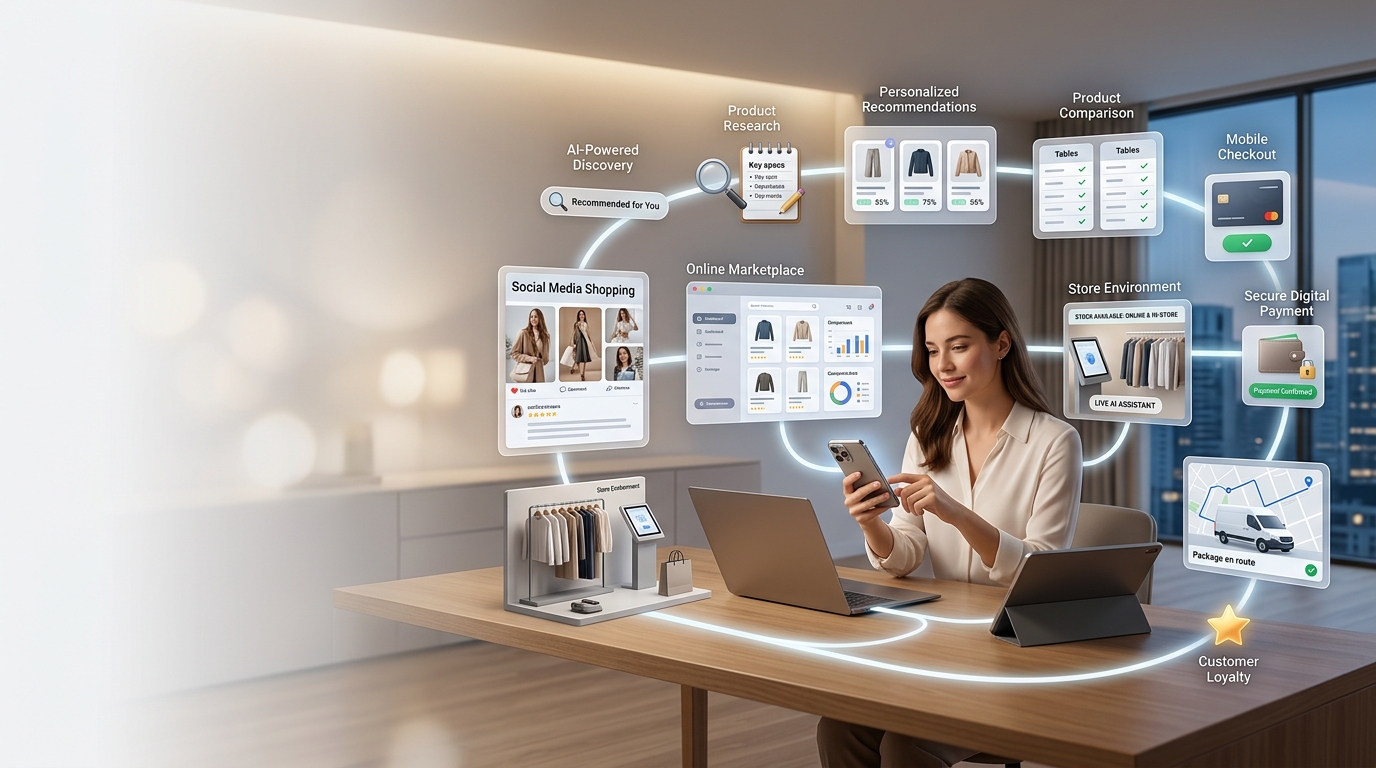
A product journey maps the different interactions a customer has with a brand, from initial discovery through purchase and beyond. In 2026, this journey is increasingly non-linear. Customers can move between search engines, AI assistants, social platforms, physical stores, marketplaces, mobile apps, and brand websites before making a decision.
The core stages include:
- Discovery: Customers discover products through search engines, AI-powered search, social commerce, marketplaces, recommendations, advertising, and word-of-mouth.
- Consideration: Customers evaluate product information, specifications, reviews, videos, comparisons, pricing, availability, and brand credibility.
- Decision: Customers choose a product, select options, add it to their cart, and complete checkout using their preferred payment method.
- Post-Purchase: Order confirmation, delivery tracking, customer support, returns, reviews, loyalty programs, and personalized follow-up shape the ongoing relationship.
- Retention and Re-Engagement: Relevant recommendations, replenishment reminders, loyalty benefits, and personalized experiences encourage repeat purchases.
The goal is to make every stage feel connected and purposeful, rather than forcing customers to repeatedly search, enter information, or navigate between disconnected experiences.
Principles of Seamless E-Commerce UX in 2026
Modern e-commerce UX should remove unnecessary effort while giving customers enough information to make confident decisions.
Clarity and Simplicity
Product names, prices, promotions, availability, shipping costs, specifications, and calls-to-action should be immediately understandable.
Customers should not have to hunt for essential information or reach checkout before discovering unexpected fees.
Personalization Without Overcomplication
AI-powered recommendations can help customers discover relevant products, accessories, bundles, and alternatives. However, personalization should feel useful rather than intrusive.
Businesses should use customer data responsibly and provide experiences that add genuine value.
Speed and Performance
Fast-loading pages remain fundamental to e-commerce success. In 2026, businesses should optimize images, scripts, third-party integrations, Core Web Vitals, mobile performance, and checkout functionality.
A visually impressive store that responds slowly can still create significant friction.
Mobile-First Experiences
For many customers, the smartphone is the primary shopping device. Product pages, navigation, filters, forms, payment flows, and customer support should therefore be designed around mobile usability first, rather than simply adapting desktop layouts.
Consistency Across Channels
Customers increasingly move between websites, mobile devices, social platforms, marketplaces, messaging channels, and physical locations.
Product information, pricing, availability, promotions, and customer accounts should remain as consistent as possible across these touchpoints.
Trust and Transparency
Trust is especially important when customers encounter AI-generated recommendations and increasingly automated shopping experiences.
Clear reviews, authentic product imagery, transparent pricing, secure payment options, return policies, delivery information, business details, and accessible customer support can help customers purchase with confidence.
Accessibility and Inclusive Design
A seamless experience should work for as many customers as possible. Accessible navigation, readable typography, appropriate contrast, keyboard support, descriptive labels, captions, and clear error messages can make e-commerce easier to use for everyone.
Designing for Discovery and Consideration
The first stages of the product journey determine whether customers continue exploring or leave.
AI-Powered Product Discovery
In 2026, product discovery increasingly extends beyond traditional keyword searches. Customers may use conversational queries, AI shopping assistants, visual search, voice search, or recommendation systems to find products.
E-commerce businesses should therefore create product information that is structured, descriptive, accurate, and easy for both humans and intelligent systems to understand.
Smarter Search and Filtering
Search should understand customer intent rather than relying only on exact keywords.
Useful features include:
- Predictive search suggestions
- Natural-language queries
- Intelligent filters
- Product attributes
- Synonym recognition
- Visual search
- Search personalization
- Clear zero-result recommendations
The objective is simple: help customers reach the right products with as little effort as possible.
Personalized Recommendations
Recommendation engines can use browsing behavior, purchase history, product relationships, and contextual signals to surface relevant products.
Examples include:
- You may also like
- Frequently bought together
- Recently viewed products
- Accessories and compatible products
- Personalized collections
- Alternative products based on budget or preferences
The best recommendations should feel like useful assistance rather than aggressive upselling.
Rich Product Experiences
Customers cannot physically touch or examine products online, so product pages need to reduce uncertainty.
High-quality product experiences can include:
- Multiple product images
- Demonstration videos
- 360° views
- Product comparisons
- Size and fit guidance
- Detailed specifications
- Customer reviews
- FAQs
- User-generated content
- Availability information
- Delivery estimates
The more confidently customers understand a product before purchasing, the less likely they are to abandon the journey or return an unsuitable item.
Streamlining the Decision and Checkout Process
Once a customer has decided to purchase, unnecessary friction can quickly turn a conversion into an abandoned cart.
Simplified Checkout
Keep checkout focused on the information required to complete the transaction.
Consider:
- Guest checkout
- Autofill
- Saved customer information
- Address lookup
- Fewer form fields
- Clear order summaries
- Transparent shipping costs
- Simple error correction
Flexible Payment Options
Customers expect convenient payment methods that match their location and preferences.
Depending on the market, businesses may offer cards, digital wallets, bank transfers, local payment methods, and installment or buy-now-pay-later options.
The important principle is to provide choice without overwhelming the customer.
Clear Progress and Feedback
Customers should always understand what is happening.
Useful feedback includes:
- Cart updates
- Stock availability
- Shipping estimates
- Payment confirmation
- Form validation
- Order summaries
- Checkout progress indicators
- Clear confirmation messages
When something goes wrong, the interface should explain what happened and how to fix it rather than simply displaying an error code.
Conversational and Assisted Commerce
AI-powered shopping assistants are increasingly becoming part of the e-commerce experience.
They can help customers:
- Find suitable products
- Compare options
- Answer product questions
- Explain specifications
- Recommend complementary products
- Guide customers through purchasing decisions
However, businesses should ensure that automated assistance remains accurate, transparent, and easy to hand over to a human when necessary.
Creating a Better Post-Purchase Experience
The customer journey does not end when payment is completed.
A seamless post-purchase experience can include:
- Immediate order confirmation
- Delivery updates
- Shipment tracking
- Easy access to invoices
- Proactive delay notifications
- Simple returns and exchanges
- Product setup guidance
- Customer support
- Review requests
- Loyalty rewards
- Relevant replenishment reminders
This stage is especially important because a smooth post-purchase experience can turn a first-time buyer into a repeat customer.
Using AI Without Losing the Human Experience
AI is becoming an important part of e-commerce in 2026, but automation should not replace good UX.
Businesses can use AI to support:
- Product recommendations
- Customer-service chat
- Search and discovery
- Product descriptions
- Personalized merchandising
- Demand forecasting
- Customer segmentation
- Fraud detection
- Marketing personalization
However, AI-generated experiences should be monitored for accuracy, bias, irrelevant recommendations, misleading information, and privacy concerns.
The strongest e-commerce experiences use AI to remove repetitive friction while keeping the customer in control.
Measuring Success in Seamless E-Commerce
A seamless product journey should be measured through both business outcomes and customer experience signals.
Important metrics include:
- Conversion rate: Percentage of visitors who complete a purchase.
- Cart abandonment rate: Helps identify friction during product selection or checkout.
- Checkout completion rate: Measures how effectively customers move from checkout initiation to payment.
- Average order value (AOV): Indicates the effectiveness of merchandising, bundles, and cross-selling.
- Customer lifetime value (CLV): Helps measure the long-term value of customer relationships.
- Repeat purchase rate: Shows whether the experience encourages customers to return.
- Search-to-purchase rate: Measures how effectively product discovery leads to transactions.
- Product-page engagement: Helps identify whether customers are finding and consuming useful information.
- Customer satisfaction: Reviews, surveys, support interactions, and other feedback reveal qualitative issues.
- Return and refund rates: Can highlight product-information or expectation gaps.
- Mobile conversion rate: Helps identify differences between mobile and desktop experiences.
In 2026, businesses should avoid relying on a single metric. Conversion rate alone cannot explain whether an experience is genuinely seamless. A stronger measurement framework connects UX improvements with revenue, retention, satisfaction, and customer value.
The Future of Seamless E-Commerce
E-commerce is moving toward experiences that are increasingly connected, intelligent, conversational, and personalized.
Customers may discover a product through an AI assistant, investigate it through a brand website, compare it through social content, purchase it through a mobile device, and track delivery through a messaging platform.
For businesses, this means the product journey can no longer be designed as a simple sequence of website pages. It must be considered as an ecosystem of connected customer touchpoints.
The brands that succeed will be those that make these interactions feel coherent, trustworthy, and effortless.
Conclusion
Seamless e-commerce in 2026 is about much more than creating a functional online store. It is about designing an intelligent, connected product journey that helps customers discover, evaluate, purchase, and engage with products with minimal friction.
Businesses can improve the experience by combining fast performance, mobile-first design, intuitive navigation, useful personalization, AI-assisted discovery, transparent product information, flexible checkout, strong trust signals, accessibility, and reliable post-purchase support.
The ultimate goal is not simply to make customers buy faster. It is to make every interaction clearer, easier, more relevant, and more trustworthy.
When customers feel confident and supported throughout the journey, e-commerce becomes more than a transaction. It becomes an experience that encourages conversion, satisfaction, loyalty, and long-term customer relationships.